
How Roof Pitch and Azimuth Affect Annual Solar Yield in the US, UK, and EU
Understand how roof tilt (degrees vs. US rise/run) and compass azimuth shape annual solar kWh across latitudes. Includes worked US, UK, and EU examples showing when east-west arrays outperform south-only assumptions.
Updated 2026-11-20 · 1486 words
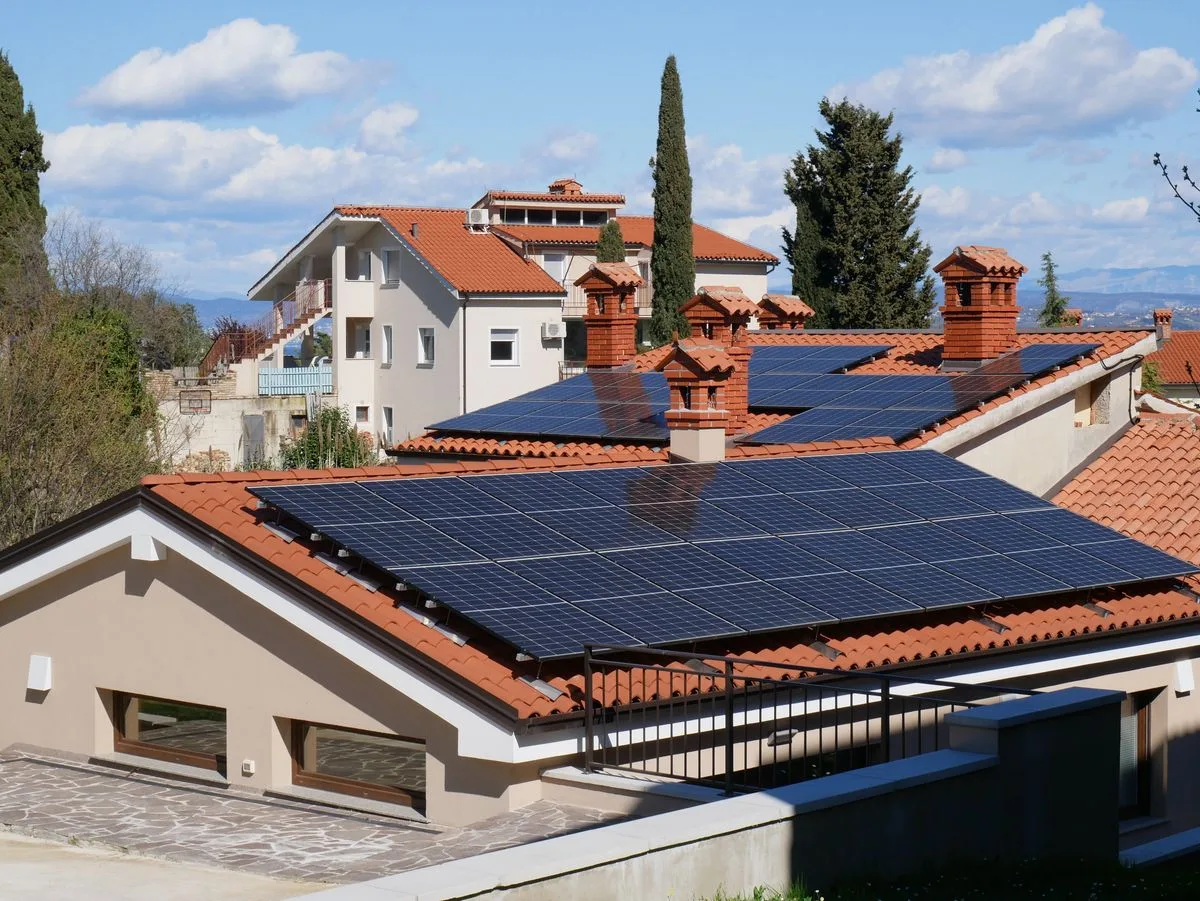
Why Roof Geometry Dictates Both Annual kWh and Daily Timing
Before a single solar rail is bolted to a rafter, two geometric angles determine how much sunlight your roof intercepts across the year: roof pitch (tilt from horizontal, measured in degrees or US rise-over-run like 6:12) and azimuth (compass bearing, where 180° is true south in the Northern Hemisphere). While homeowners often assume only a due-south roof is worth covering, modern module prices and time-of-use electricity tariffs have made east, west, and low-slope installations far more competitive than they were a decade ago.
The physics comes down to the cosine of the angle of incidence: sunlight strikes a panel with maximum intensity when rays hit perpendicular (90°) to the glass. Because the sun climbs much higher in summer than in winter—and sits lower overall in Manchester or Berlin than in Dallas or Madrid—the "ideal" roof pitch shifts noticeably with latitude.
Understanding Pitch: Degrees vs. US Roof Slope (Rise/Run)
In the UK and continental Europe, builders and solar designers specify roof tilt in degrees above horizontal (typically 30° to 45° for pitched clay or slate roofs). In the United States, roofers usually quote pitch as inches of vertical rise per 12 inches of horizontal run:
- Flat / Low-Slope (0°–10°, or 0:12 to 2:12): Common on commercial buildings, modern extensions, and southwestern parapet roofs. Panels are often ballasted on 10°–15° tilt frames to shed rain and dust.
- Low Residential Pitch (18°–23°, or 4:12 to 5:12): Typical of ranch-style homes across the US Sunbelt and Pacific Northwest. Performs strongly in summer when the sun sits high overhead.
- Medium Pitch (27°–34°, or 6:12 to 8:12): The all-around sweet spot for mid-latitude North America (35°–45° N) and Southern/Central Europe, balancing summer cooling loads with shoulder-season output.
- Steep Pitch (37°–45°, or 9:12 to 12:12): Standard across traditional UK semi-detached homes, Northern Germany, and New England colonials. Sheds snow rapidly and captures low winter sun angles efficiently.
Azimuth: True South vs. Magnetic Compass & East-West Splits
When measuring azimuth, always distinguish true south (180°) from magnetic south on a smartphone compass. Magnetic declination shifts compass readings by up to 15° west in Maine or 12° east in Oregon, and by ~0° to 4° across the UK and Central Europe. Satellite tools like NREL PVWatts and PVGIS always use true geographic azimuth.
Equally important, an azimuth 45° off true south—southeast (135°) or southwest (225°)—typically sacrifices only 4% to 7% of annual energy on a 25°–35° roof. Even due east (90°) or due west (270°) retains roughly 78% to 85% of due-south annual yield on moderate pitches, while shifting generation toward morning breakfast routines or late-afternoon peak utility rates.
Pitch & Azimuth Yield Multipliers Across Latitudes
The table below compares approximate annual yield retention (relative to an optimal due-south array at each city's latitude) using NREL PVWatts and PVGIS solar geometry benchmarks.
| Roof Orientation & Pitch | US Sunbelt (~33° N, Dallas/Phoenix) | US Midwest / Central EU (~42°–48° N, Chicago/Munich) | UK / Northern EU (~52°–54° N, Leeds/Hamburg) | Key Tariff & Operational Trait |
|---|---|---|---|---|
| Due South (180°), 18° (4:12) | 97%–99% | 93%–95% | 89%–92% | Strong May–Aug peak; slower winter snow shedding |
| Due South (180°), 30°–35° (7:12–8:12) | 99%–100% | 99%–100% | 98%–100% | Maximum annual kWh benchmark across most homes |
| Due South (180°), 45° (12:12) | 92%–94% | 96%–98% | 98%–99% | Boosts Dec–Feb sun capture; excellent snow shedding |
| Southeast / Southwest (135° / 225°), 30° | 94%–96% | 94%–96% | 93%–95% | Minimal annual penalty; SW aligns with late-day AC |
| Due West (270°), 22° (5:12) | 84%–87% | 81%–84% | 78%–82% | Captures expensive 4 p.m.–7 p.m. US TOU peak rates |
| East + West Split (90° + 270°), 30° | 83%–86% | 80%–83% | 78%–81% | Flattens midday spike; raises direct self-consumption |
Worked Numerical Walkthroughs: US, UK, and EU
Walkthrough 1: US Time-of-Use Trade-off in Atlanta, Georgia (33.7° N)
A homeowner in Atlanta with a 2,500 sq ft house has two unshaded roof planes available for a 7.2 kWp array (eighteen 400 W panels): a 6:12 (26.6°) south-facing back roof and a 6:12 west-facing side roof. Under a flat $0.14/kWh net-metering tariff, the south roof wins cleanly, generating ~10,450 kWh/year ($1,463/year value) versus ~8,980 kWh/year ($1,257/year) on the west plane.
However, if the homeowner enrolls in a Time-of-Use (TOU) plan charging $0.26/kWh between 2:00 p.m. and 7:00 p.m. on summer weekdays and $0.09/kWh off-peak, the west roof generates nearly 40% more kWh during that 2:00 p.m.–7:00 p.m. air-conditioning window. Modeling hourly production shows the west-facing array can match or slightly beat the south array in dollar savings despite producing 14% fewer annual kWh.
Walkthrough 2: UK East-West Semi-Detached Home in Leeds (53.8° N)
A 92 m² semi-detached house in Leeds has a gable ridge running north-south, leaving only an east roof (90°) and a west roof (270°), both pitched at 35°. Rather than abandoning solar, the owner installs 6 panels (2.4 kWp) on the east plane and 6 panels (2.4 kWp) on the west plane for 4.8 kWp total on a 3.68 kW G98 inverter:
- Annual Yield: PVGIS estimates ~790 kWh/kWp for 35° east/west in Leeds, delivering 4.8 × 790 = 3,792 kWh/year (versus ~4,610 kWh/year if the exact same 4.8 kWp faced due south).
- Self-Consumption Advantage: Because morning generation starts by 6:30 a.m. in summer and afternoon generation lasts past 7:30 p.m., a work-from-home household self-consumes ~48% of output directly (saving £455/year at £0.25/kWh) and exports ~1,970 kWh under SEG at £0.15/kWh (£295/year), totaling roughly £750/year without needing a huge midday export spike.
Walkthrough 3: EU Roof Pitch Comparison in Berlin, Germany (52.5° N)
Compare a 6.0 kWp south-facing array in Berlin mounted on a steep 42° clay-tile roof versus a shallow 15° dormer extension. According to PVGIS:
- 42° Steep South Roof: Produces ~1,045 kWh/kWp = 6,270 kWh/year, with stronger December–February winter output (roughly 18% higher winter kWh than a 15° tilt) to support a heat pump when electricity costs €0.38/kWh.
- 15° Shallow South Dormer: Produces ~940 kWh/kWp = 5,640 kWh/year (about 10% less annually), concentrates more generation into June–July midday hours when feed-in is ~€0.08/kWh, and requires gentle rinsing every couple of years because dust washes off more slowly below 15°.
Seasonal Sun Paths: Why Winter vs. Summer Tilt Preferences Diverge
If your utility offers 1-to-1 annual net metering—meaning every surplus kilowatt-hour exported in June offsets a kilowatt-hour imported in January—you simply want the roof angle that maximizes total 12-month kWh, which typically sits 5° to 10° shallower than your latitude. However, in markets without 1-to-1 net metering (such as the UK Smart Export Guarantee or Germany's low feed-in tariff paired with high winter heat-pump demand), when your panels peak matters just as much as total annual production.
In December at 52° N (London or Berlin), the midday sun climbs only ~15° above the southern horizon. A steep 40°–45° roof faces that low winter beam far more directly than a 15° shallow extension, boosting winter daily kWh by 18% to 25% when grid import prices bite hardest. Conversely, in Phoenix (33° N) where summer air-conditioning loads dominate July afternoons at 105 °F (40.5 °C), a shallower 18°–22° roof (4:12–5:12 pitch) captures high summer sun angles efficiently without over-exposing panels during cool winter months when electricity usage is modest.
Stringing Rules When Mixing Roof Pitches and Azimuths
Whenever you place panels across two different roof planes—such as 8 panels facing east and 8 facing south, or a 35° main roof plus a 15° dormer—electrical string design becomes critical:
- Separate MPPT Channels: Never wire panels from two different orientations or pitches into the same series string on a standard string inverter. Each orientation needs its own independent Maximum Power Point Tracking (MPPT) input so the shaded or lower-angle plane does not drag down the sunny plane.
- Minimum String Voltage Check: Putting only 3 or 4 panels on a small dormer string may fall below a central string inverter's startup voltage (often 120 V to 200 V). In those split-plane layouts, microinverters or DC power optimizers allow every single panel on small dormers or hip facets to contribute independently.
Why Tilt-Up Racking on Pitched Roofs Rarely Pays Off
Homeowners with shallow north-facing or flat-ish 10° roofs sometimes ask installers to build angled aluminum "tilt-up" triangles on a pitched roof to force panels to 30° facing south. In practice, tilt-up legs on pitched residential roofs are almost never recommended: they multiply wind-uplift forces on roof rafters, cast self-shading onto the row behind them (requiring wide gaps that cut panel count by 30%–40%), and look visually intrusive to neighbors or HOA boards. Simply adding two or three extra flush-mounted panels on an east or west plane is usually cheaper, safer structurally, and produces more total kWh.
Roof-Survey Measurement Checklist
Before finalizing your array layout, confirm these five geometric details:
- Measure roof pitch on each candidate plane using a digital inclinometer app against an interior attic rafter (safer than climbing onto the roof).
- Check true azimuth on aerial satellite maps (accounting for magnetic declination if using a handheld compass).
- Note whether your utility bills on flat net metering (favoring maximum annual kWh toward south) or Time-of-Use / low export tariffs (making west or east-west splits attractive).
- Confirm that low-slope roofs (<12°) either use ballasted/tilted racking rated for local wind zones or allow safe periodic cleaning access.
- Avoid mounting panels on steep north-facing roofs (>20° pitch facing 315°–45°) in Northern Hemisphere mid/high latitudes, where annual yield often drops 35%–50% below south-facing planes.
Safety & Engineering Disclaimers
The yield multipliers and worked examples above are educational benchmarks based on NREL PVWatts and European Commission PVGIS solar geometry models; actual roof production depends on horizon shading, local microclimates, and utility rate changes and cannot be guaranteed. Never climb onto pitched, wet, or fragile tile/slate roofs to measure slopes yourself—use interior rafter measurements or aerial LiDAR surveys, and leave all structural roof penetrations, wind-load engineering, and electrical wiring to licensed professionals.